The Coen Lab
Cell and Developmental Biology department, University College London
In the natural world, brains are faced with a mixture of sensory cues from multiple modalities. For example, when listening to someone speak, we combine the sounds they produce with their lip movements—which is one reason that masks make conversations more difficult! How and where are these auditory and visual streams of information combined in the brain? Our lab uses the mouse model system to answer this question.
We train mice to perform complex behaviours in custom-designed audiovisual chambers. We combine these behaviours with the latest electrophysiology tools and optogenetic manipulations to dissect the neural circuits that underlie audiovisual integration. We aim to determine how and where these sensory modalities are combined in the brain, both to localize external objects in space and to localize oneself when navigating a multisensory environment.
Join us!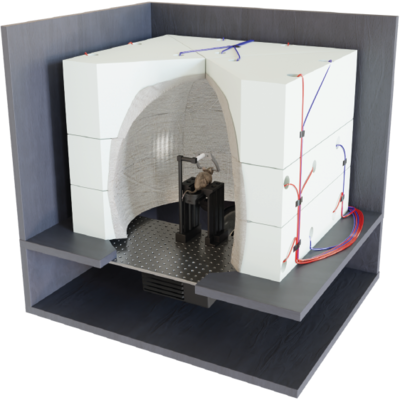
Behaviour
Custom-designed acoustically transparent domes for immersive audiovisual environments
Electrophys
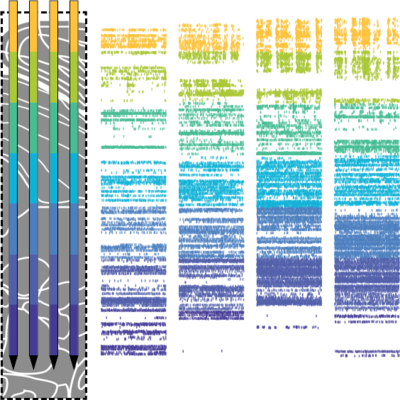
Chronic Neuropixels 2.0 recordings to record hundreds of neurons over weeks
Optogenetics
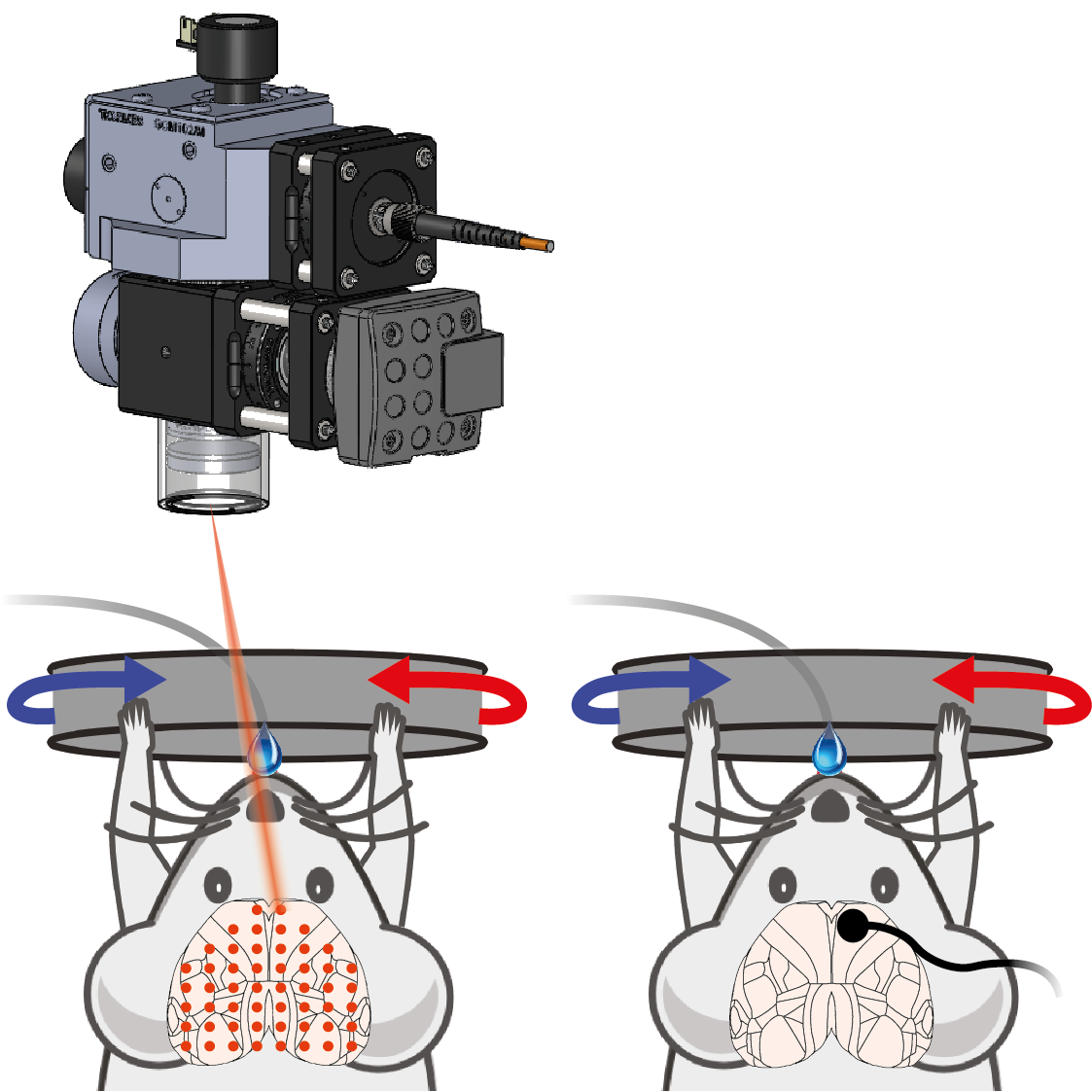
Perturbing brain regions during behaviour using transcranial and cannula-based approaches
Recent news
Zapit version of record at eLife
The Zapit paper is now published as the version of record at eLife. Assessed as important with compelling evidence, it describes the first open-source general-purpose platform for laser-scanning photostimulation in head-fixed mice.
Samantha joins the lab as a Research Assistant
Samantha Huang is joining the lab as a Research Assistant, supporting experiments across the lab. Outside the lab she knits, crochets and bakes (disclaimer: the baking was not considered in the hiring process). Welcome, Samantha!
Giana joins the lab as a PhD student
Giana Lee joins the Coen Lab this week as a joint iCASE PhD student with NeuroGEARS, through the UCL–Birkbeck MRC Doctoral Training Partnership. Giana's project will investigate audiovisual integration in clinical mouse models. Welcome to the lab, Giana.
Second annual lab retreat in the Peak District
The Coen and Rossi labs spent four days in Matlock in the Peak District for our second joint retreat, with paired talks pitching joint project ideas, fiercely contested PI bingo, and a slightly damp walk through Eyam and Abney.
Anisha completes her summer placement
Anisha Hasan finishes her eight-week In2Research placement, presenting a poster on mouse exploratory behaviour in the open field arena. She returns to King's College London to continue her Biochemistry degree.
Pip and SAFE Labs feature in Nature article on leaving the lab
Pip Coen, a founding member of SAFE Labs, is quoted in a Nature careers article on leaving a lab well, arguing that telling your supervisor early gives the whole group time to plan.
Ainiah co-organises the 2026 Neuronauts Summer School
Ainiah Masood and Mehul Rastogi organised the 2026 Neuronauts Summer School, with help from Gerion Nabbefeld. Twenty London secondary school students ran projects ranging from flies driving cars to light-sensitive 3D prints.
Zapit reviewed preprint is now live at eLife
The Zapit reviewed preprint is now live at eLife, describing the complete open-source platform for random-access laser-scanning photostimulation in head-fixed mice, a collaboration across eight labs.
Three lab members presenting at FENS Forum 2026
Ainiah Masood will chair a symposium (S35) and present a poster (PS07-084), Hamid Türker (PS05-600) and Gerion Nabbefeld (PS07-526) will present posters at the FENS Forum 2026 in Barcelona this July.
Anisha joins for the summer
Anisha Hasan joins the Coen Lab for a summer placement through the In2Research programme. Anisha is a Biochemistry student at King's College London.
Superior colliculus preprint on bioRxiv
New preprint led by Flóra Takács, recording from the mouse superior colliculus during multisensory decisions. The SC promotes competing actions independently of sensory inputs, with sensory integration instead handled by frontal cortex.
Hamid attends Paris Neuro Course
Hamid Türker is attending the Paris Neuro Course (PNC) 2026 on optical imaging and electrophysiological recording in neuroscience, a two-week intensive programme running 11-23 May in Paris.
Gerion awarded UCL Talent Gateway placement with NeuroGEARS
Congratulations to Gerion Nabbefeld on being awarded a UCL Talent Gateway Programme placement. Gerion will be working with NeuroGEARS for 4 months, strengthening the lab's experimental control and Bonsai workflow infrastructure.
Pip appointed to the eLife Board of Directors
Pip has been appointed as a non-executive director on the eLife Board of Directors, representing early career researchers. The role involves three meetings per year and an equal vote on the organisation's strategic direction.
Tom accepted onto Neural Systems & Behavior course
Congratulations to Tom Childs on being accepted onto the prestigious Neural Systems & Behavior (NS&B) course at the Marine Biological Laboratory in Woods Hole — an intensive summer programme in experimental neuroscience.
Updated Zapit preprint now live on bioRxiv
The updated Zapit preprint (v3) is now live on bioRxiv, describing our complete open-source platform for random-access laser-scanning optogenetic experiments in head-fixed mice — a collaboration across multiple labs.
Ryan accepted onto the SWC Neuroinformatics course
Congratulations to Ryan Shen on being accepted onto the NIU Open Software Summer School at the Sainsbury Wellcome Centre — a hands-on course in open-source tools for systems neuroscience.
Pip chaired session at Royal Society Theo Murphy Meeting
Pip chaired a session at the Royal Society's Theo Murphy scientific meeting on "Vision Augmented Hearing," bringing together researchers studying how the brain combines visual and auditory information to improve hearing in complex environments.
SAFE Labs featured in Nature
The SAFE Labs initiative was featured in Nature, highlighting how lab handbooks can improve research culture. The article profiles the SAFE Labs handbook as one of a growing number of resources helping groups establish fair and transparent working practices.
Gerion awarded Marie Curie Individual Fellowship
Congratulations to Gerion Nabbefeld on being awarded a prestigious Marie Skłodowska-Curie Actions (MSCA) Individual Fellowship, providing two years of funding to investigate how behavioural task structure and state shape audiovisual strategies, regions, and connections in the mouse brain.
Hamid awarded Marie Curie Individual Fellowship
Congratulations to Hamid Türker on being awarded a prestigious Marie Skłodowska-Curie Actions (MSCA) Individual Fellowship, providing two years of funding to develop novel tools for studying audiovisual integration in freely-moving mice.
Pip & Shuting Han receive collaboration award
The UCL Neuroscience – Neuroscience Center Zurich (ZNZ) Collaboration Fund will support new joint projects between the Coen Lab and the Shuting Han group at ZNZ.
Tom awarded Bogue Fellowship
Congratulations to Tom Childs on being awarded a prestigious Bogue Fellowship, which will support a research visit to a collaborating lab in the USA.
"SAFE Labs Handbook" paper published
The SAFE Labs Handbook paper is published at eLife, describing 30 practical commitments for improving research culture in the life sciences, developed by 13 group leaders across Europe.
Tom joins as a PhD Student
Tom Childs officially joins the lab for his PhD, where he will lead the development of new audiovisual navigation paradigms for studying multisensory spatial processing. Welcome Tom!
FENS 2026 symposium accepted
Ainiah's symposium "The brain in context: flexible neuronal processing across behaviors and states" has been accepted at FENS 2026 in Barcelona. Co-chaired by Ainiah Masood and Shuting Han, July 9th.
PhD available in audiovisual integration
The lab is advertising a fully funded MRC iCASE PhD with NeuroGEARS and Caswell Barry, investigating audiovisual integration in clinical mouse models using chronic Neuropixels recordings in freely moving mice.
Ryan joins as a technician
Ryan Shen joins the lab as a technician, taking on everything from 3D printing and rig building to animal training and lab management. Welcome Ryan!
Hamid joins as a research fellow
Hamid Türker joins the lab as a Research Fellow from the USA, bringing expertise in designing freely-moving behavioural experiments and building new experimental tools. Welcome Hamid!
Pip awarded Royal Society Research Grant
Pip is awarded a Royal Society Research Grant to support the lab's research on audiovisual integration in freely-moving mice, funding new behavioural arenas and chronic electrophysiology equipment.
Ainiah and Gerion TA the Neuronauts Summer Camp
Ainiah Masood and Gerion Nabbefeld volunteer as teaching assistants at the Neuronauts Summer Camp at the Sainsbury Wellcome Centre — a two-week outreach programme teaching neuroscience, engineering, and AI to London secondary school students.
"Layers 2/3 vs 5" preprint now live on bioRxiv
New preprint showing that mouse primary visual cortex integrates visual and non-visual information differently across cortical layers — layer 2/3 is dominated by visual signals while layer 5 is more strongly modulated by movement.
Tom joins for a PhD Rotation
Tom Childs joins the lab for a PhD rotation project, working on developing new audiovisual virtual reality environments for mouse behaviour.
Maimoona joins for a summer project
Maimoona Rashid joins the lab through the UCL Careers Extra Undergraduate Summer Research Studentship scheme, working with Ainiah on developing ZapitPy — a Python port of the Zapit optogenetics control software.
Tom, Ainiah, and Gerion accepted onto the SWC Neuroinformatics course
Congratulations to Tom Childs, Ainiah Masood, and Gerion Nabbefeld on being accepted onto the NIU Open Software Summer School at the Sainsbury Wellcome Centre — a hands-on course in open-source tools for systems neuroscience.
Jenkin joins for a summer project
Jenkin Zhang joins the lab for a summer research project, contributing to ongoing audiovisual behaviour experiments. Welcome Jenkin!
Qimin completes their Masters Project
Congratulations to Qimin Wu on successfully completing their Masters project in the Coen Lab, working on predicting mouse performance in audiovisual behavioural tasks.
We had our first annual lab retreat
The lab held its first annual retreat in Italy, hosted together with the Rossi lab at the Italian Institute of Technology — a great opportunity for science and team building.
Pip joins Wellcome Brain & Behavioural Sciences Advisory Group
Pip has been appointed to the Wellcome Trust's Brain and Behavioural Sciences Discovery Advisory Group, which advises on funding decisions for discovery research grants in neuroscience and behavioural sciences.
Ainiah attends Paris Neuro Course
Ainiah Masood is attending the Paris Neuro Course (PNC) 2025 on optical imaging and electrophysiological recording in neuroscience, a two-week intensive programme in Paris.
"Apollo Implant" version of record at eLife
The Apollo Implant paper is now published as the version of record at eLife, describing our open-source chronic Neuropixels implant system for head-fixed and freely moving animals.
Gary joins as first lab postdoc
Gerion (Gary) Nabbefeld joins the lab as a Research Fellow to investigate how behavioural context shapes neural processing in mice.
"UnitMatch" paper published in Nature Methods
The UnitMatch paper is published in Nature Methods, describing a pipeline for tracking the same neurons across days in chronic Neuropixels recordings — enabling long-term studies of neural dynamics.
Superior Colliculus symposium at SFN 2024
Lab members present new findings at a symposium on the Superior Colliculus at the Society for Neuroscience 2024 annual meeting in Chicago.
Ainiah joins as first lab member
Ainiah Masood is the Coen Lab's first PhD student, working on optogenetic approaches to dissect multisensory circuits in mice.
"Apollo Implant" reviewed preprint is now live at eLife
The Apollo Implant reviewed preprint is now live at eLife, describing our lightweight, recoverable chronic Neuropixels implant system tested across eight laboratories.
Pip Awarded 2024 UCL Early Career Neuroscience Prize
Pip is awarded the 2024 UCL Early Career Neuroscience Prize at the annual UCL Neuroscience Symposium, recognising outstanding contributions to systems neuroscience research.
Pip & collaborators organize SAFE Labs
Pip and collaborators from across Europe launch the SAFE Labs initiative — a framework of practical commitments to promote safe, aware, fair, and equitable research lab cultures.
Multisensory symposium at FENS 2024
Pip co-organises a symposium on multisensory integration at the FENS Forum 2024 in Vienna, bringing together leading researchers in the field.
Come and see us at SFN
Lab members present posters on multisensory decision-making and chronic electrophysiology at the Society for Neuroscience 2023 annual meeting in Washington, D.C.
bioRxiv on "UnitMatch" published
The UnitMatch preprint is now available on bioRxiv, describing a new pipeline for tracking the same neurons across days in chronic Neuropixels recordings using only spike waveform shapes.
Pip & collaborators receive Global Engagement Award
Pip and collaborators are awarded a UCL Global Engagement Fund to support international research collaboration, fostering new partnerships in systems neuroscience across institutions.
Preliminary bioRxiv on the "Apollo Implant" is now live
The first preprint describing the Apollo implant — a lightweight, recoverable chronic implant system for Neuropixels probes — is now available on bioRxiv. A collaboration across multiple labs.
Symposium talk at IMRF
Pip presents new results on multisensory integration in mouse cortex at a symposium at the International Multisensory Research Forum (IMRF) 2023.
Symposium talk at Japan Neuroscience
Pip presents findings on audiovisual decision-making in an invited symposium talk at the annual meeting of the Japan Neuroscience Society.
Wellcome Trust Career Development Award
Pip receives a Wellcome Trust Career Development Award, providing funding to establish the Coen Lab at UCL and begin investigating the neural circuits underlying audiovisual integration in mice.
ERC Starting Grant
Pip is awarded a prestigious European Research Council Starting Grant to investigate how brains combine auditory and visual information, providing five years of funding for the lab's multisensory integration research programme.